K9 security and executive protection address different security needs. A K9 unit uses appropriately trained dogs and handlers for assigned security tasks, while executive protection focuses on planning and managing security for individuals who require additional protection.
The right arrangement depends on the environment, the client’s requirements, the assessed risks and the provider’s verified capabilities. K9 deployment and personal protection should be planned by appropriately qualified personnel rather than treated as interchangeable services.
What Is a K9 Security Unit and When Is It Used?
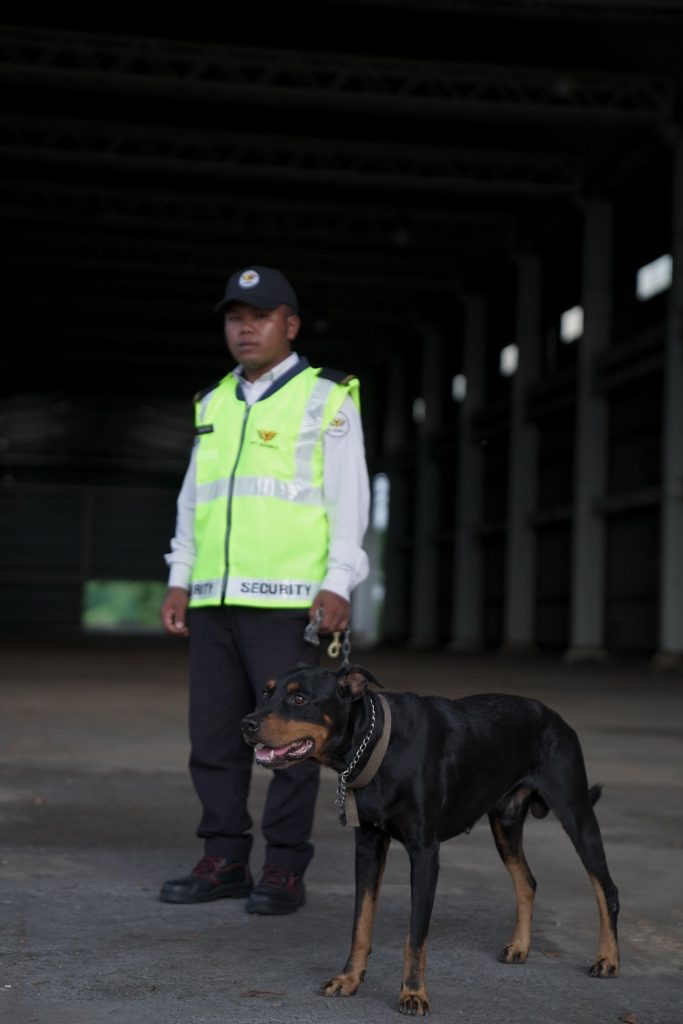
A K9 security unit typically consists of a trained dog and its handler. Depending on the dog’s training, the handler’s qualifications and the service arrangement, a K9 unit may be deployed for specific security tasks at designated premises or events.
Potential applications, where supported by the provider’s actual capabilities, may include:
- Site security support: Assist with designated security operations at suitable locations.
- Event security support: Support an approved event security plan where K9 deployment is appropriate.
- Perimeter-related duties: Perform assigned tasks within a clearly defined operational scope.
- Coordination with other security personnel: Work alongside guards and site management under agreed procedures.
K9 services should never be described as automatically providing explosive detection, narcotics detection, tracking or other specialist functions unless the relevant training and capability have been verified.
A responsible K9 deployment plan should consider the location, expected visitors, public access, animal welfare, handler supervision and procedures for responding to incidents.
What Does Executive Protection Involve?
Executive protection is planned security support for individuals who may require additional protection because of their role, public profile, travel arrangements or specific assessed risks.
Depending on the agreed service and the provider’s verified capabilities, planning may include:
- Reviewing the individual’s schedule and relevant security requirements.
- Coordinating arrival and departure arrangements.
- Identifying suitable access points and meeting locations.
- Communicating with authorised representatives and venue personnel.
- Establishing emergency contacts and escalation procedures.
- Maintaining appropriate confidentiality around personal and itinerary information.
Executive protection is not simply assigning a guard to accompany someone. It requires clear responsibilities, appropriate personnel and coordination with the client.
Armed protection, specialised threat assessment, advance security work and other specialist functions must be verified separately rather than assumed to be included.
Registered Personal Bodyguards in Malaysia
Bernama reported on 9 October 2025 that 1,247 personal bodyguards were registered nationwide in Malaysia at that time. This figure provides context for the country’s personal-protection workforce; it does not measure demand for executive protection or confirm the qualifications of any particular provider.
Clients considering executive protection should verify the personnel’s experience, training, service scope and relevant authorisations. K9 services should be assessed separately, including the dog’s actual training, handler qualifications and permitted duties.
How to Choose Between K9 Security and Executive Protection
The two services serve different purposes. Use the following 3-step assessment to identify the type of support to discuss with a security provider.
Step 1: Identify the security objective
Is the requirement related to a site, a particular operation, an event or an individual? Define the objective before choosing the service.
Step 2: Confirm the required capabilities
For K9 services, ask about the dog’s training, handler qualifications, permitted duties and deployment conditions. For executive protection, confirm personnel qualifications, scope of work, communication arrangements and emergency procedures.
Step 3: Review the operating plan
Confirm where the service will operate, who will supervise it, how it will coordinate with other security personnel and how incidents will be documented.
This three-step process is a practical selection framework, not a formal industry certification or guarantee of results.
Frequently Asked Questions
1. What is a K9 security unit?
A K9 security unit consists of a dog and handler trained for specified security duties. The actual tasks depend on the training, qualifications and service scope.
2. Are K9 security dogs suitable for every event?
No. Suitability depends on the event environment, public access, the assigned task, the dog’s training and the relevant safety arrangements.
3. What is the difference between VIP protection and ordinary guarding?
Ordinary guarding usually focuses on premises, access control and patrols. Executive protection is planned around an individual and may involve specific movement, venue and coordination requirements.
4. Does executive protection always include armed guards?
No. The service scope and applicable authorisations must be confirmed. Clients should not assume that armed protection is included.
5. How can I verify a K9 or executive protection provider?
Ask for details of the actual services offered, relevant personnel qualifications, operating procedures, licensing and any specialist capabilities required for the assignment.
Conclusion
K9 security and executive protection require different skills, procedures and deployment plans. Confirming the objective, required capabilities and operating conditions helps clients identify the appropriate service for their needs.
Need to discuss K9 security or executive protection in Malaysia? Contact SPZ Security to confirm the services available and discuss the requirements of your site, event or assignment.